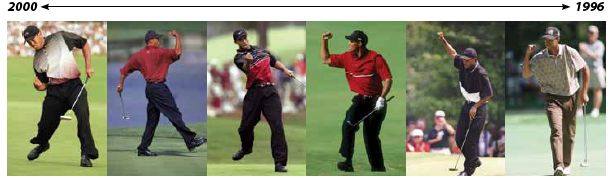


Tiger Woods is driving the change in the perception of golf to that of an athletic sport and will be known as the player that influenced an evolutionary change in how the game is learned and played forever more.
- share:
 Bookmark on Delicious
- Digg this
- Recommend on Facebook
- Share on Orkut
- Share on Reddit
- Share with Stumblers
- Tweet this
- Tell a friend
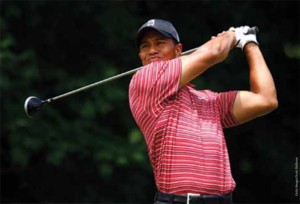
For centuries the game of golf has been considered a game in which the royal, the elite, and the privileged participated in a leisure fashion. Then came advances in golf course design, and golf equipment, which increased the demands for more skill and brought out the likes of Snead, Hogan, Player, Palmer and Nicklaus.
These were probably the first signs that golf changed from more of a game to a sport, but it wasn’t until this past decade in which Tiger Woods’ influence and domination, forced a real and permanent change in the way professionals train and the way the golf public will learn, practice and play in the future
A New Paradign For Professional Golf
It was evident from the TV accounts that we have all seen of him as a toddler, that Tiger was born with a passion for golf and was destined to be the greatest player that has ever lived.
The movie The Natural was released way prematurely. Woods was the Natural long before Robert Redford. There are athletes who changed their sport in ways that are almost indefinable. For example, Babe Ruth turned baseball from a bunt and run game into a power game that led to today’s more athletic era. Johnny Unitas changed the NFL from a slight diversion from college football to the biggest sport on America’s part of the planet. Wilt Chamberlain and Michael Jordan both changed basketball in their own ways, Wilt through sheer, awesome power and Michael through grace and determination, as well, Wayne Gretzky changed hockey into a game more fit for magicians on ice than toothless goons.
So where does Tiger fit in when it comes to changing golf? His swing is not as smooth as Hogan’s. He doesn’t putt like Crenshaw. He doesn’t drive like Nicklaus if you compare the equipment.
He simply changed the game unlike any icon in sports. He’s one of the few athletes that the public identifies with on a first-name basis (OK, Tiger’s real name is Eldrick). He’s become a corporate icon making more money than his accountants can count and he’s changed the game of golf. He won a U.S. Open on one leg and he’s gone from a scrawny kid who won the U.S. Amateur three times to a muscle-bound hulk who pays attention to his nutritional intake and does yoga and weightlifting in the same day. Forget his legendary eight-hour practice sessions; he does almost as much at the gym as he does on the driving range.
Does anyone say golfers aren’t athletes anymore? That used to be a common stigma. Golfers were like bowlers or fishermen playing a game. Very skilled, but “not athletes” was the standard critique. Tiger changed all of that. Tiger is definitely an athlete, as are the top players now on the PGA Tour, not to mentionthe LPGA and Champions Tour.
Since the start of Tiger’s ascendance to the top of the PGA Tour, other golfers have followed his model. Tiger went to the gym; started working on continuing his string of major champions, up to 14 as of July 4, and most everyone else took note. When Retief Goosen won the Transitions Championship in Palm Harbor, Fla., in March, he credited his conditioning along with Woods as the reason.
“I was looking at myself in the mirror and thinking, ‘I look a bit out of shape,’’Goosen said after winning The Transitions. “I started working hard in the gym and I figured instead of being totally out of shape and struggling I might as well be totally in shape and struggling. I feel better about myself and a lot of it has to do with what Tiger has brought to the Tour. I feel better about myself now and am a lot more consistent. I think the whole Tour has learned a lesson from Tiger.’’
Padraig Harrington won the last two majors of the 2008 season – The British Open and the PGA Championship – and he said at Bay Hill this year that Tiger inspired him to work even harder. Harrington doesn’t work out the conventional way; he plays rugby and boxing.
“I don’t know that Tiger had anything to do with my success but he makes me work harder,’’ Harrington said. “I hope it keeps going that way. Tiger has a lot of wins and there’s a huge gap between my two (majors) and his however many, but he’s made it a different game. We have to be in shape to compete with a guy who wins on one leg.’’
Woods himself just laughs and shrugs off any implication that he works harder at fitness than anyone else. To Woods, it’s just part of the game, part of the game that involves eight hours of practice every day and a few more hours at the gym. None of that interferes with trying to be a father of two young children. It comes natural to Woods who has won on one leg, battled allergies throughout his career, not to mention cameramen and galleries that rival those of Hannah Montana.
“It felt good and it was because of hard work,’’ Woods said during the Arnold Palmer Invitational after sinking a long putt on the 72nd hole for his second straight win at Arnie’s big event. “You do what you have to do and you put the work in and it pays off. I was hurt last year but I don’t feel like I ever left.’’
Does it ever get boring, the same workout, the same routine, day after day when you have accomplished so many goals and made enough money to last several life times? “If you put the work in and that means on the range and in the fitness room, it pays off,’’ Woods said. “When you stop working at it, that’s when you lose your edge. It’s as important what you do on the course as what you do off the course.’’
Sean O’Hair, who won the Quail Hollow Championship and finished second to Woods at the Arnold Palmer Invitational, could only marvel at Woods’ achievements after the knee injury.
“He won (the U.S. Open) on one leg,’’ O’Hair said in March at The Transitions. “He works harder than everyone and just has that talent. He’s an example of what hard work and fitness can do.’’
Speaking of the 2008 U.S. Open, Rocco Mediate knew he was playing with someone who could barely walk his way around Torrey Pines that Monday when Woods won on the 91st hole. Mediate himself had missed a large chunk of his career to back injuries and had nothing but kind words to say about Woods and what his fitness meant to one of golf ’s epic championships.
Mediate has been suffering from his knee injury throughout the early part of the 2009 season. He’s had a meniscus tear since 2007 but has soldiered on ever since. He said Tiger’s strength was a source of inspiration on that final day at Torrey Pines.
“It was more of a pain but it had to be done,’’ Mediate said. “Tiger went through his injuries and we all go
through them. I wish I was in the shape he is in now. He works hard and you can tell. Tiger still isn’t the Tiger we all know. When he starts making putts he will be the Tiger we all know and that will be the end of that.’’
When it comes to golf fitness, no one is better versed than Gary Player. The South African was one of the Big 3, along with Jack Nicklaus and Arnold Palmer, throughout most of the 1960s and early 1970s. While “Fat Jack’’ and “The King’’ were both known for their girth, it was Player who brought fitness to the game of golf and is what he feels gave him a competitive edge to challenge the world’s best players. Even today, at 73, he counts 9 majors and 24 wins on the regular Tour, 19 wins on the Champions Tour and over 120 others from around the globe, and has a body that would put to shame many of the young guns on the PGA Tour.
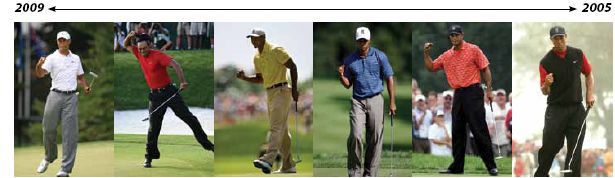
Player has said that there is little doubt that Tiger has revolutionized the game, even more than the hi-tech equipment changes and the “Tiger-proofing’’ of some of America’s most beloved courses.” So has the game changed
since Player was battling Palmer and Nicklaus? “Yes, no doubt,’’ Player said. “Many of the older guys are not as in
shape, but the younger ones are seeing the success of those like Tiger and beginning to take notice that it takes
both mental and physical strength to win a tournament. We are seeing more players bringing trainers along with
them to tournaments.’’
’It isn’t just the PGA fitness trailer,” Player said. “Woods has influenced the way golfers are looking at the game in
other ways.”
“On the other hand, many of the Tour players have poor eating habits. I believe you are what you eat and with the
amount of travel we do, unless they select wisely what they put into their bodies, it may not matter how athletic they
are. Some foods are literally poisons.’’
Player admits that Tiger’s success has been noticed by the rest of the Tour and is making a big impact on how the game is perceived. “He raised the bar for those on Tour,’’ Player said about Woods.
Brad Brewer, who owns and runs the Brad Brewer Golf Academy in Orlando, Fl., and is an award winning teaching
professional and author, gives his perspective on what Tiger has done.
“Tiger Woods has changed competitive golf in quantum leap, greater than any gap I’ve seen in sports history. This also follows the second greatest performance increase that we witnessed by Michael Jordan in the NBA. In the eyes of all athletes, golf has become a ‘real sport’ and the majority of its performers have evolved into conditioned athletes. Prior to Tiger, we had our unique stand out, like Player, Palmer, Norman and Faldo that maintained a strong presence. But nothing like Tiger.”
Susan Hill, President of Fitness for Golf.com, and a fitness trainer with multiple certifications, feels that Woods has revolutionized physical training in golf. “I think most people would agree that golf has never been considered an athletic sport,’’ Hill said. “While other sports like baseball, football and basketball have embraced physical and mental training, golfers tended to focus mostly on the technical aspects of the game. It wasn’t until the introduction of Tiger Woods onto the scene that golfers began to understand and apply the principles of true athletic conditioning for golf.’’ Hills website is dedicated to helping golfers improve their game with golf-specific programs and training methods. She
and her site have worked with more than 10,000 golfers in over twenty-two different countries.
Hill goes on to explain, “It’s the concept of “periodized training that moved Tiger into a different realm. Periodized
training, which has long been used in other sports, follows a model where athletes map out an entire competitive
season so they can peak at a given event. Tiger Woods was among the first to use this system of training. Once golfers of all levels saw his dominance in the sport, each began emulating his patterns and behaviors. Today, this periodized approach to training is being taught to all junior golfers coming up through the ranks. This is why the future of golf will likely be younger and younger golfers pushing the envelope of what can be achieved in the sport.’’
A New Paradigm For “Leisure” Golf
Tiger’s impact has not only been felt by those who make millions of dollars and fly personal jets from site to site. His
influence is now reaching far beyond that. Today’s golfers are seeing and learning the changes being promoted
by professionals who teach golf game improvement. More and more golf teaching facilities are incorporating a
total approach, which includes assessment and golf-specific fitness, to helping golfers improve their body movement,
their health, and their play.
Brewer feels that the entire philosophy of conditioning the golfer body has changed since he was a young professional
player. “Back in the early 70s when I began playing the instructors and coaches would tell us that any upper
body workout, other than hands, forearm and stomach, was not advised. No pushups, no swimming or rowing,
no upper body weight lifting.
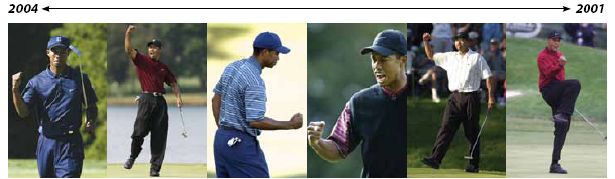
According to what I have read on tigerwoods.com, Tiger is lifting upper body every day as part of his routine. And certainly his physical power is evident. Part of our player development services includes a sport specific trainer
that works in tandem with the instructors and our clients. Fitness and health education is a vital element of game
improvement in the millennium thanks in greater part to Tiger’s lead.”
Player acknowledged, “If golfers, professional or amateur took their health seriously they would not only be more
focused players, but be able to enjoy the game well into their latter years. I’m 73-years-old, and still as strong and fit
as I was in my 40s. Leisure golfers could begin with a simple rule: Walk, don’t ride carts. The discipline one has with
his health and fitness not only bulk up muscle, but add to one’s mental strength, and for some this is not only their
toughest critic, but determines whether they play well or not.”
Andy Brumer has written more than 40 books about golf and said that, while Tiger’s athleticism was the key to his
ferocious swing, fitness had a lot to do with his success, although he still credits Player with being the pioneer to the
fitness movement in golf.
“I don’t see (Woods) as the beginning of this change in perception because Gary Player and others began to train with weights, diet, fitness in general many decades ago and they took their lead from Gary,’’ Brumer said. “ But I do think that many of the best young athletes are choosing golf today in greater numbers than ever before and Tiger has certainly influenced that. I would say that the overwhelming majority of them will integrate golf-specific physical training into their overall strategy for playing their best golf.’’
Susan Hill feels that Tiger has influenced “a true evolutionary change in how we approach training and practicing
by incorporating all the elements of success, as opposed to all the emphasis being on good technique and finesse.”
Greg Rose, founder of the Titleist Performance Institute and the golf fitness industry’s leading researcher, may have
the ultimate word when it comes to Tiger and his fitness and the earthquake effect it has had on sports and the
PGA Tour.
“If golfers, professional or amateur took their health seriously they would not only be more focused players, but be able to enjoy the game well into their latter years.” – Gary Player
Rose, co-host of Golf Fitness Academy on the Golf Channel and has talked about Tiger many times. “Before Tiger,
the world questioned if fitness was important or even needed at high level golf,’’ Rose said. “Now, over a decade
later, the world wants to know what Tiger does in the gym because they know it is one of his secrets to success.’’
The world has definitely changed. It is obvious that what Tiger has done for the mix of golf and fitness is something that would have been laughed at during the days of Nelson, Snead, and Hogan. The improvements in golf fitness since Tiger has changed the game have changed the world of golf completely and for the better.
“I don’t know that I work harder than anyone else,’’ Woods said after winning at Bay Hill. “I just know that if you don’t work hard you can’t keep up on the Tour anymore. It’s a different game today. The guys in the past worked their own way but today it’s different.’’
Given the recent success of players like Tom Watson, who at 59-years-old dominated the field for four days at the 2009 British Open as well, Bernhard Langer who is currently dominating the Champions Tour. We can only imagine what Tiger will accomplish between now and 2035 when he turns 59.
Tiger’s influence will continue to push the envelope in professional golf and will facilitate exciting changes to the way
we learn, practice and play. We are all witnessing and living a new paradigm in the bright future of golf.