



- share:
 Bookmark on Delicious
- Digg this
- Recommend on Facebook
- Share on Orkut
- Share on Reddit
- Share with Stumblers
- Tweet this
- Tell a friend
Most people think that the benefits of golf fitness are reserved for maximizing driving power along with preventing or reducing injury and rehabilitation. Few would consider fitness as a means of improving their putting stroke. By defining the specific skills and fundamentals that are required of putting, an exercise program can be created to improve the putting motion, making you a better putter.
The simple goal of any putting method is to refine the stroke, so you can consistently at impact square the putter’s path and face to the intended target line. The most consistent stroke is the pendulum-style stroke that de-emphasizes the use of the hands and wrists. The arms, shoulders and putter should move back and forth as a single unit while the head and lower body stay still.
Even the slightest lower body movement can cause the putter face to turn, sending the ball off line. So one of the main keys to improving putting is learning how to keep the lower body quiet by integrating some stability exercises into a player’s putting practice.
The most effective way to stabilize the lower body is to make some putting strokes while standing on unstable surfaces like an Airex pad, disc pillows and a half foam roller (with the flat side down and progressing to the flat side up).
But before working on stability, it is important that the golfer can consistently produce a pendulum motion by maintaining the integrity of the triangle (arms and shoulders) while standing on a solid flat surface.
The following two exercises are done on a flat surface and are designed to help you know what a pendulum motion feels like:
1. Tie a loop at each end of a light tension elastic band. These bands are made of thin flat rubber about six inches wide and can be cut to specific lengths. Place each hand through a loop and then wrap the band over the shoulders and down the arms (see photo below). The pull of the band will activate the adduction, movement toward the central axis of the body, of the inner arms and chest muscles unifying the triangle. Make a back and forth putting motion.
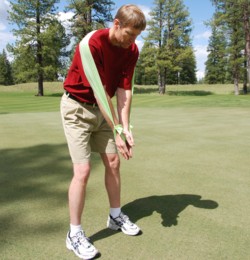
2. Place a putter handle or a three pound dumbbell between your palms. Press the palms together with the fingers pointing downward. But keep the hands together, not separated. The hands should be firmly enough together to hold the putter or dumbbell securely without using the fingers. Arms should be bent with elbows folded or press into the hips or sides. This isometric exercise works, also, to give you a light contraction of the inner arms and chest muscles. Rehearse the putting stroke with this palm together position.
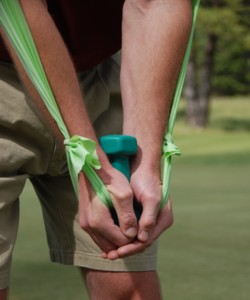
Now that you have developed the proper feel of the pendulum stroke, repeat these exercises while standing on an unstable surface such as an Airex pad, disc pillow or a half foam roller as mentioned earlier. While practicing your stroke, focus your eyes on a specific spot on the ground where the ball would be placed—that will produce a still head.
The pendulum motion is powered by the oblique abdominals, not by the arms or shoulders as most people think. To develop a feel for the oblique muscles, do the following exercise:
1. Secure one end of an exercise tube band to a solid fixture or hook. Grasp the other handle with both hands as if it were a putter handle. With the tube slightly stretched (as pictured) begin to make some putting strokes—further stretching the tubing. The tension will engage the muscles of the abdominals so that you can feel the correct rotational motion of the stroke.
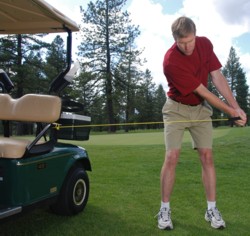
2. Repeat the exercise while standing on an unstable surface.
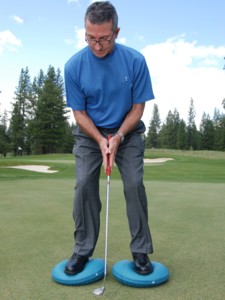
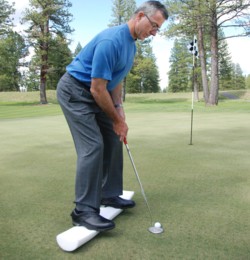
Be certain to practice these exercises a few times a week. Your putting stroke will eventually become more solid and consistent.
Keith Lyford, Director of Instruction at The Golf Academy at Old Greenwood, former PGA Tour player and a member of the Titleist Professional Advisory Board. Mark Tedsen, Golf Fitness Instructor at the Tahoe Mountain Club and Titleist Performance Institute (TPI) certified.
For more information visit www.oldgreenwoodgolfacademy.com or call or (530) 550-2670.