



- share:
 Bookmark on Delicious
- Digg this
- Recommend on Facebook
- Share on Orkut
- Share on Reddit
- Share with Stumblers
- Tweet this
- Tell a friend
Pre-season
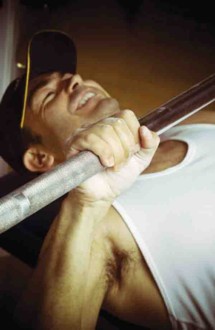
It’s the time to get ready to start playing golf. Your fitness program should reflect exercises that will immediately affect your game. These parameters are flexibility, power, balance and cardio-respiratory conditioning.
We have defined flexibility above, however, power, balance and cardio-respiratory conditioning are defined as follows:
Power is determined by the formula of force multiplied by distance, divided by time and is an accepted measure of strength and speed. Training your muscles to contract in an explosive manner will help increase club head speed, which ultimately increases driving distance.
Additionally, power training can also help prevent injury because the training stresses of speed and force closely resemble those experienced on the course.
Balance, as it refers to pre-season training, is the ability to maintain correct postural alignment, essential to accomplishing any movement pattern. The body relies on three systems to maintain balance: vision (the eyes), vestibular (the inner ear), and proprioception (sensory receptors found in joints and soft tissue). Maintaining position and alignment is a learned and trainable fitness parameter.
Any change and/or loss of balance within the golf swing will change the relationship of club face to the ball and have a dramatic effect on the ball’s direction of flight. Training your body’s “balanced position” and mid-section stability both with and without a club in your hand, will translate to a more controlled and stable swing and fewer trips to the rough and/or the pro-shop for new balls.
Cardio-respiratory conditioning: Golf is a game of nerves, both mentally and physically. Mentally, you need to be able to “see the big picture,” but still be able to focus on the details of the moment. Physically, you need to have control over both gross and fine motor skills, which are affected by the fitness level of your cardio-respiratory system.
The affects of your aerobic (with oxygen) fitness level on your golf game tend to be evident during the course of a round. As you combat fatigue, all aspects of your game quietly erode. As you get tired you tend to change your posture, your relationship to the ball and your gross motor skills. Hence, your swing changes and your game is negatively affected.
There have only been a handful of studies that have examined the affects of anaerobic (without oxygen) fitness, on your game. However, it is evident that a lack of anaerobic capacity can trigger a decrease in fine motor skills (short game) within a single shot at that critical moment between address and ball strike.
In-Season
It is at this time that you begin playing more and that your fitness program should become secondary. Your valuable time should be focused on practice. There are however, a few physiologic parameters that you can work on during this time. This is an excellent time to continue improving or maintaining your flexibility as well as improving your motor control/core stability.
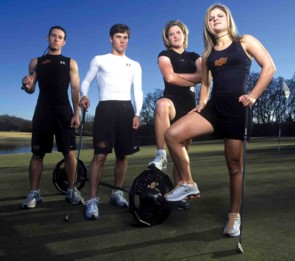
Motor Control/Core Stability is enhanced through anchoring exercises, which are designed to build the functional relationship of each joint to its related muscles. This phenomenon is illustrated by Michael Jordan soaring through the air from the foul line to one of his patented dunks. As Michael makes his way to the hoop, his lower body moves in one direction, his head in another and his arms in yet another.
Have you ever wondered where his anchor is, and from where the movement is initiated? The answer is that as he moves through the air he dynamically stabilizes his center, and using it as the keystone to his movement.
The greater the muscle’s ability to work, separately and collectively with its related joints, increases the body’s ability to maintain correct alignment throughout the performance of any movement pattern, especially throughout a golf swing. This stabilization is started from the center of your body, referred to as your “core.” Core stabilization is vital to the performance of many athletic skills.
The ability to contract your trunk musculature is essential to providing a stable base from which your extremity musculature can pull. Not only is establishing this stable base important from a strength perspective, but also from a motor control perspective. Mastering the ability to instinctively contract your core muscles will significantly improve your chances of being able to replicate your golf swing over and over.
Post-Season
The last season or is one of rest and recovery. However, I feel that flexibility is such a vital component to the program it should be a part of every season including the Post-season.
The key to improving your physiologic parameters such as strength, flexibility, power, balance, motor control/core stability and cardiovascular levels is to receive immediate and consistent feedback. The trick for any golfer is to “put it all together” the same way, at the same place, each and every time, over and over and over again. The consistency comes from an adequate fitness level within each physiologic parameter at the correct time during the golf season. Most golf-conditioning programs neglect these important physiological parameters as well as their link to the “seasons of golf.”
As you can see, golf fitness must be planned based on your volume of play. It is not just a collection of “golf-specific” exercises it is a collection of traditional fitness exercises done at the correct time. This is what makes them “golf-specific exercises.” You now understand the physiologic parameters that your program should consist of and when you should perform the exercises.
Improvements in your physical deficiencies will peak during your highest volume of play; thereby, improving your play through better fitness. Incorporating Seasonal Training into your golf game can lead to better golf as well as a healthier lifestyle.
John Stemm, M.ed., PT, is the Associate Director of Athletic Training/Rehabilitation for Oklahoma State University. He serves as the athletic trainer for golf programs and was the strength and conditioning coach for the 2006 National Champion Men’s Golf Team. He is the featured instructor for the E.D.G.E. series golf fitness DVD’s