



- share:
 Bookmark on Delicious
- Digg this
- Recommend on Facebook
- Share on Orkut
- Share on Reddit
- Share with Stumblers
- Tweet this
- Tell a friend
I’m going to once again remind Golf Fitness Magazine readers that human beings in general are goal-oriented, goal-driven creatures. Every single day of our lives we move from one goal to the next, even though the goal may not have been written out or planned. Some of our goals are simple, like turning off the light before we go to bed.
In the last issue I stressed the importance of knowing what you want. I challenged you to take the first step toward finally realizing your true potential by coming up with your very own crystal clear goals. In case you missed it, some of the simple criteria in coming up with your own goals are as follows:
1) The goal(s) you set for yourself must be your goal(s) and not a goal that someone else wants for you. This is important because if you do not have a burning desire to achieve the goal, then most likely you will not put forth the effort or do what it takes to achieve the goal.
2) Your goals should be specific. “I want to become a better golfer,” or “I want to be stronger,” are not specific. “I want a six handicap,” or “I want to be able to do thirty pushups and run five miles” are specific. Being as specific as you can will keep your vision well defined.
3) Choose a goal that is realistic, and pick a date on which to complete your goal. For example, “I would like to increase my driving average by 20 yards, within 90 days from today.”
4) Write your goal(s) down. Remember, if it’s not written down, it is a dream, not a goal. Dreams rarely come true; well-planned goals almost always come true!
5) Based on the goals that you have come up with, write your very own mission statement to keep you motivated when things may not seem to be going your way.
Very exciting stuff! Now that we have a clear vision of what we want or where we want to go, we are ready to take the important next step. This step is, in my opinion, the missing goal-setting link for most people—the step that most of us overlook. And because it is overlooked, it is so easy to completely lose the desire to follow through with our goals, as they quickly begin to feel unattainable. Think of it like this: Do any of you have one of those fancy GPS systems that you can put in your car or even carry around town with you? They are truly amazing devices! In reality, they are goal-setting machines. The first thing you do when using your GPS is to enter a very specific destination into the device. It then very quickly maps a detailed route to the chosen destination. This map could be considered step #2 in the goal-setting process. The system has swiftly calculated the simplest and quickest route to your destination/goal. The incredible thing about these systems is that they even recognize potential detours, and suggest alternate routes to the chosen destination. What value would the same system have if it skipped the detailed mapping part, and merely informed you of your arrival at the destination? The map is the key! The value in these systems is most certainly the detailed route, flexibility and attention to detail. So many of us choose goals, but so few of us have a plan to attain them. Enjoy the process of devising your own map now that you know where you want to go.
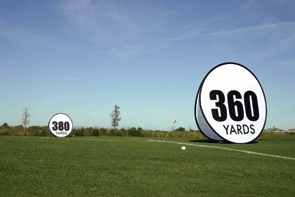
 Here’s a very simple example of a goal that many of you would probably like to accomplish in your golf game: more distance. Let’s say 20 more yards with your driver, to be specific. Am I correct in assuming that just about every golfer would want to hit the ball 20 yards farther? Assuming that I am, and having determined a very specific and attainable goal, let’s look at a way we can map out a plan so this goal is not just a dream. If I were a cool GPS system, how could I draw a detailed map that would allow you to arrive at your destination of gaining 20 yards with your driver in the quickest amount of time possible, say, 90 days?
Step #1: Break It Down
(What factors go into hitting a golf ball far?)
• Technology—Get clubs that suit your body and swing.
• Technique—Some quick tweaks from your
local pro could go a long way.
• Strength, Flexibility and Speed—A golf-specific strength
and conditioning program will work wonders.
Step #2: Make Your First Move
(Take immediate action.)
• Schedule an appointment for a
professional club fitting.
• Schedule an appointment with a
local golf professional.
• Schedule an appointment with a
conditioning specialist/ personal
trainer for some golf-specific
training.
Step #3: Commit To A Program
• Put your new, personalized golf equipment in the bag.
• Create a 90-day game improvement program
with your golf professional.
• Create a 90-day strength and conditioning program.
After completing step #3 you will, without question, feel like you are already on your way to reaching your goal(s). Having come up with a map, or plan of attack, you have now enabled yourself to simply enjoy the process of following the directions you established.
In the next issue of Golf Fitness Magazine, I’ll share the third and final phase of the three-step program to achieving greatness with goals: The execution of your plan. I’ll give you insight into how to really enjoy the process of following your goal plan, along with some thoughts and ideas on how to handle unexpected bumps along the way.
Bill McInerney Jr. has been a professional golf performance coach since 1994. He is TPI certified and was recently recognized by Golf Range Magazine as one of the “Top 50 Best Golf Instructors” in North America.