



- share:
 Bookmark on Delicious
- Digg this
- Recommend on Facebook
- Share on Orkut
- Share on Reddit
- Share with Stumblers
- Tweet this
- Tell a friend
Rob Mottram is no stranger to the fitness and performance side of golf. He’s a registered physical therapist, Titleist Performance Institute advisor, and an athletic trainer who worked for 11 years as a rehab and fitness specialist for the PGA Tour, Senior PGA Tour and the LPGA (1987-1989). While traveling with the Tour professionals, Mottram discovered the need for pre-season fitness physicals to assess the golfers for potential early injuries and limitations as they related to their golf ability.
In the late 1980s, Mottram helped develop the Centinela Hospital Fitness Institute’s Golf Performance Evaluation, given to professional and amateur golfers, to assess their level of fitness and wellness as it relates to their game. Mottram currently owns and operates the Golf Health and Performance Center at Mission Hills Country Club in Rancho Mirage, Calif., home of the LPGA Kraft Nabisco Championship. There with other health care and fitness professionals they evaluate, treat and train golfers of all ages and skill levels.
Recently Golf Fitness Magazine spoke with Mottram about some of the most common assessment failures he sees when screening golfers. We were surprised to learn that many golfers do not have the control or mobility to pass basic golf assessments.
“Unfortunately many golfers I assess have limited physical abilities as they relate to the golf swing,” said Mottram. “If you think about it, the golf swing is a high speed, high range of motion, highly-skilled activity that can challenge the body’s capabilities. Most of the players I assess are not physically able to perform the required body movements involved in a mechanically correct golf swing.” Often, these limitations lead to unnecessary stress to various joints and muscles, especially the lower back, which can cause common golf related injuries. Mottram said that far too often we blame a poor shot on our equipment or not being able to perform a move learned from a golf pro, when actually the culprit is often our physical limitations that prevent us from making a good shot.
With many professional and competitive golfers failing these assessments, we wondered how many average golfers are not physically able to pass these basic golf ability assessments. You may be surprised to learn that the majority of his clients do not fair well with this evaluation.
To safely and accurately assess a golfer’s physical limitations, Mottram and his associates start by obtaining a brief medical background to identify any underlying pain, or acute or chronic issues through a questionnaire and interview process. They look for lingering ailments or previous injuries that may still be bothering the golfer or issues that might lead to further injury if not identified. The golfer is then put through an extensive assessment process for a complete evaluation.
“These assessments are a good foundation to gauge any golfer’s physical limitations,” Mottram said. “The assessments don’t always translate into how good of a player you are. I see many golfers who don’t do well in the assessments, but are able to play very well and the opposite are true as too.” Nevertheless, identifying areas of weakness or lack of mobility, will always lead to implementing the proper treatment or exercises to improve their golf ability and reduce the risk of injury.
Mottram states that the assessments are just half of the big picture.
“Once you have completed the assessments and have a proper conditioning program, it should be communicated and incorporated with the swing coach’s program,” he said. “The two programs work better if the health/fitness coach and swing coach work together to improve the player.”
At Golf Fitness Magazine, we thought it would be beneficial for our readers to find out if they were physically capable of performing a mechanically correct swing without physical limitations. So we asked Mottram to touch on three basic assessments the average golfer can do by themselves without the help of a pro. The assessments are; the Overhead Deep Squat, the Open Books Arm Bent Test and the Single Leg Bridge Extension.
We were astonished to learn that 75 percent of the golfers Mottram evaluates have issues with the Overhead Deep Squat assessment.
“The overhead deep squat test is a very informative test you can perform which can identify many aspects related to the golf swing with one test,” he said. “The deep squat is used to assess bilateral, symmetrical, mobility of the hips, knees and ankles. When you hold a golf club overhead and do your squats, the test assesses bilateral and symmetrical mobility of the shoulders as well as the thoracic spine.”
Statistical research at TPI (Titleist Performance Institute) has found several correlations between the Overhead Deep Squat and the golf swing. If a golfer is unable to perform a full deep squat with their heels on the ground, then it can be difficult for them to maintain their posture during the downswing. The action of thrusting the lower body towards the golf ball and raising up of the torso during the downswing (early extension) is common. Early extension is a thrusting of the hips toward the golf ball. This is seen as a forward movement during any portion of the golf swing in which the hips get closer to the position of the golf ball. It might happen at the beginning of the backswing, during transition or during the downswing.
“Early extension may be due to either tightness in the golfer’s calf muscles and or lack of hip mobility or pelvic stability due to weakness in their core,” he said. “This is one of the major contributors to lower back stress and injuries we see in the golfers we screen.”
When a golfer can’t squat with the club over their head properly, there is a strong correlation between that and players standing up out of their posture during the back swing (loss of posture/flat shoulder plane). Mottram said that this is usually due to limitations in mobility of their lat muscles and thoracic spine. In an attempt to get the arms and club up to the top of the back swing the golfer will lift their body instead of separating their arms while maintaining the correct body postures. From here the golfer needs to recover from this loss of position which usually means loss of energy and poor timing.
Overhead Deep Squat
To perform this test, begin by standing with your feet shoulder width apart and toes pointing forward. Next grasp a club about 6 inches wider than the width of your shoulders and extend the arms directly overhead, keeping the shaft in-line with your head and over your foot print. Next, simply squat down as far as you can go, while keeping the club as high above your head as possible. You must keep the heels on the ground at all times. After you have gone down as far as you can go, keep the club high above your head and stand back up.
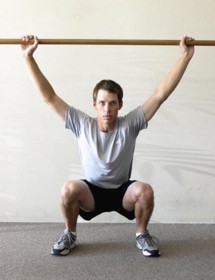
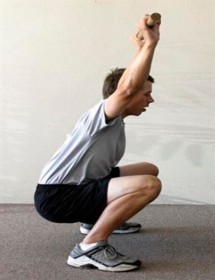
Mottram believes that one of the main reasons many golfers fail this assessment is because our culture doesn’t place a high demand on performing those motions on a daily basis. “As we sit at our desk or car or just generally sit in chairs instead of on our haunches, our bodies adapt and slowly regress from being able to perform a deep squat,” he said. “Unfortunately this takes away from our abilities to maintain our postural angles; keep our hips from thrusting towards the ball and obtaining center face contact with the ball on a repeatable basis during our golf swing.” Obviously if you have had a significant orthopedic injury that restricts this movement we would expect a limited test result.
Golfers do a little better on the second assessment, the Open Books Arm Bent Test. Only half fail this test. The Open Books test checks the flexibility of your pectoral (chest) muscles, upper spine/rib cage and overall shoulder joints in a simulated golf rotational movement. Turning to the top of the swing requires rotation through many joints with the overlying muscles and tissue having to stretch. Without these coupled movements joint separation is difficult.
Open Books Arm Bent Test Exercise
To perform this exercise, lie on your side with your hips and knees bent to 90 degrees and use the bottom hand to hold the knees together. Take your top arm and bend the elbow to 90 degrees. Keeping your knees in contact with the ground, try to rotate your top arm all the way back toward the floor. Try to touch your forearm to the ground, keeping your elbow bent and at eye level. Return and repeat on both sides.
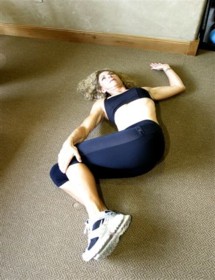
“We find that the younger women are more successful with the Open Books test because of their flexibility,” said Mottram. “As men get older they tend to lose their flexibility in the chest, shoulders and rib cage.”
The third test, the Single Leg Bridge Extension, has a failure rate of about 70 percent.
“The Single Leg Bridge Extension is a superb exercise for assessing the strength of the glutes, and core stability,” he said. If the pelvis can remain high and level throughout this test then the hip to core control is fairly good. Since we look at pelvis and abdominal cage for power generation, energy transfer, spine protection and posture control, this ability is important.
Single Leg Bridge Extension
Lying flat on your back with your hips and knees bent, feet flat on the ground, and knees and feet together. Lift your hips up off the ground then extend one leg straight out so it’s parallel to the other leg. Trmaintain a high and level pelvis and focus on firing the glute and minimizing the hamstring involvement. Hold for up to 10 seconds. Then repeat on the other leg.
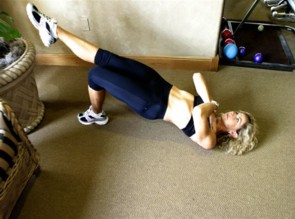
“When we don’t use certain muscle groups like the glutes, they tend to turn off,” he said. “Then the body tries to compensate when we try to perform a task that requires those muscles.” This can lead to inconsistent and potentially harmful movements.
Being able to do all three of these basic assessments with relative ease should give you piece of mind that you are improving your ability to make a correct golf swing without certain limitations. If you had trouble doing any of these, it would be in your best interest to seek out a golf physical therapist or a golf certified trainer to find out exactly where your limitations lie before spending time and money on new equipment and additional lessons.
For more information on the Golf Health and Performance Center, visit the Web site www.golfpt.com. To find a golf fitness professional in your area, . Click on Affiliates Link under Golf Fitness Tab and look for “Find a Golf Fitness Pro”.