

Crack the Whip to Get Your Swing Moving in the Right Direction
- share:
 Bookmark on Delicious
- Digg this
- Recommend on Facebook
- Share on Orkut
- Share on Reddit
- Share with Stumblers
- Tweet this
- Tell a friend

Recently, a fan favorite has returned to the PGA. After a shortened golf season due to his well documented back pain, Fred Couples has made it back. This guy looks like the Freddie we have always known. He’s the man with a silky smooth swing that bombs it 305 yards. When you watch him it barely looks like he puts any effort into his swing.
On the other hand, take a look at someone like J. B. Holmes; his swing screams power! Both golfers are considered long hitters. And although their swings look very different, they are also eerily similar.
The similarity is their golf biomechanics. Biomechanics is the study of how a golfer should specifically move their body during the golf swing. Currently, there is a large movement toward understanding and mastering the biomechanics of golf. This way is being led by golf-specific fitness and performance facilities.
A handful of companies are introducing electronic equipment that can be placed on your body to take real-time assessments and data during your golf swing. All this information can be used to determine some of the primary causes of poor swing performance due to improper firing of muscles during the swing. There is a lot of biomechanical data you can look at, but one of the key buzz terms the industry is paying attention to is called the “Kinematic Sequence.”
The Kinematic Sequence describes how the body should move in order to generate and transfer speed effectively to the club. If done correctly, this sequence allows you to hit the ball with maximum club head speed. Through kinematic studies, it was determined that the start of this sequence in the downswing begins with the pelvis followed by the upper body (thorax), followed by the arms and finally the club; and off goes your ball; hopefully where you wanted it to go!
Another way to think of the example is to imagine the cracking of a whip. In order for the tip of the whip to crack, it must travel very fast. If the handle of the whip is accelerated, and if the handle just keeps going, the energy will never build up along the whip. The handle of the whip must first be accelerated, but then rapidly decelerated (stopped) so that the energy travels along the whip efficiently, resulting in the loud crack. That’s why Mr. Couples can bomb it out there; that’s why Ernie Els is called “The Big Easy”; they are able to “crack the whip.” Their swings generate energy and speed that look effortless. Even the unorthodox swing of Jim Furyk has the same Kinematic Sequence as them. That is the beauty of this; regardless of your style, if your swing has the correct Kinematic Sequence you will build up energy and speed in the best possible way! Everyone can sequence their body in the correct way to apply all that energy they build from the top of their swing to that little white ball.
By now I’m sure you want to know how you can crack the whip and tap into this right? Well the first step is to actually be assessed utilizing this new technology. Many golf and fitness facilities are starting to incorporate it. Not only will you get a huge insight into kinematic sequencing, but also how your body works, by obtaining additional data that is captured and compared to an ideal golfing model. This data can be used by your team of golf fitness professionals and instructors to create a more focused approach to improving your game.
In the meantime, here are some great movements you can perform which will get you started on a proper kinematic sequence. These can be performed at home or on the range.
Step Change Of Direction
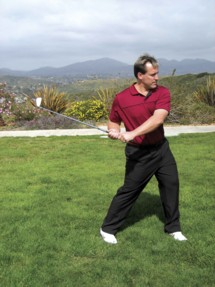
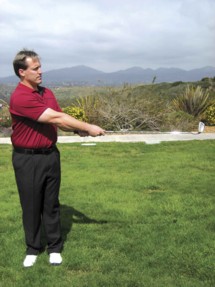
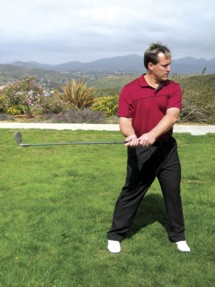
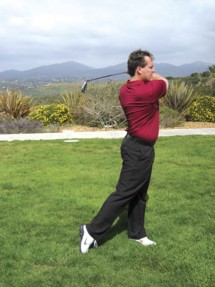
Grab a golf club and get into a golfing posture. Place both feet together and the club pointing towards your target. With your lead leg take a step towards your target as you swing the club back. Again, step and backswing at the same time. Now rapidly swing forward as you stabilize on your front posted leg. Maintain a stable core throughout the exercise.
This exercise helps to teach you how to fire your pelvis first, which is the first movement needed in the sequence.
Step 1
Step 2
Step 3
Step 4