



- share:
 Bookmark on Delicious
- Digg this
- Recommend on Facebook
- Share on Orkut
- Share on Reddit
- Share with Stumblers
- Tweet this
- Tell a friend
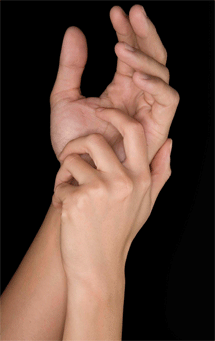
A wrist injury can be devastating for a professional golfer. Phil Mickelson had to withdraw from several tournaments this past year because of a lingering left wrist injury he sustained playing a practice round at Oakmont CC, the site of the 2007 US Open. The left-hander failed to contend seriously in any of the four major championships, because of the nagging wrist.
Wrist injuries are common among golfers and normally occur at the moment of impact of the club with the ball. Teen golfer Michelle Wie also had a disappointing year on the LPGA Tour because of a similar injury to her right wrist. Wie hit a shot off a cart path during the women’s Samsung World Championship in 2006, the injury caused her to withdraw from many tournaments and lead to a disappointing year in 2007.
Because the grip is the body’s sole connection to a golf club, wrist action is a critical part of the swing. The repetitive motions of golf and the high speed of the typical golf swing, however, place wrists at a high risk for injury. To begin with, let’s look at symptoms one might experience with an injured wrist.
- Hot Sensation in the wrist.
- Swelling in the wrist after playing a round or practice.
- Wrist feels stiff and normal movements such as opening jars, carrying luggage or shaking hands are painful the day after a round of golf or practice.
- Finding a small lump on the back on the wrist commonly known as a ganglion.
- Pressure on the top of the wrist that causes severe pain.
- Weakness in wrist and hand that increases with time.
- Severe pain in wrist and hand that leads to use of non-dominate wrist and hand.
- Increased apprehension and anxiety when using hand on a daily basis. Normal activity such as turning a door handle, picking up a golf bag and teeing up a golf bag cause pain and discomfort.
- Quitting on golf shots at impact and to make a complete golf swing.
If you are experiencing any of these symptoms before, during or after, your golf game, the next step is to get a proper diagnosis from your physician—this area of the body is very complex! An MRI is essential to locate the injury and determine whether it is tendons, bone, ligaments, nerves, joints etc. You must have a physician’s diagnosois in order to properly treat your symptoms and to get the proper rehabilitation.
Many golfers that suffer from wrist injuries have experienced a past injury to the wrist or forearm. These golfers are extremely likely to suffer a recurrence of wrist pain. Prolonged wrist injuries that are not treated can lead to more serious permanent damage in the underlying structure of the wrist such as the joint discs or ligaments.
Many of the structures that are damaged in wrist injuries, are not seen with a plain x-ray. That is why diagnosis from a physician and an MRI are so vitally important when it comes to this type of injury.
After you have confirmed your diagnosis, there are several ways in which you and your physical therapist, or physician can work together to rehabilitate your injury.
However, one must note, that many wrist injuries, as well as any other golf-related injuries, can be prevented by a pre-season and year-round, golf-specific conditioning program. The following are some of the ways in which wrist injuries are commonly treated after proper diagnosis has been made:
- rest and ice
- muscular strengthening, flexibility exercises
- a short, practical, pre-game warm-up routine
- the adjustment of an individual’s golf swing to meet their physical capacities and limitations through properly supervised golf lessons
- the correct selection of golf equipment and an awareness of the environmental conditions
- on-going physical therapy in which your team of therapists, physicians, your instructor and yourself work together to diagnose, treat, and repair.
So we have evaluated your symptoms, and informed you on some of the less complex treatments that are common for treating wrist injuries, howewever, the question still exists-how did this injury happen? The following is a detailed list of how most golf related wrist injuries occur.
The Risk Factors for Wrist Injury:
- Poor Neck Posture and Muscle Control
The body as a system is quite versatile in adjusting to adverse situations. Poor posture and lack of muscle control can easily lead to compensations in the golf swing. Instead of using large muscle groups to create power in the swing, someone with poor neck posture and muscle control may compensate by flicking the wrists and trying to help the ball up in the air putting strain on the smaller muscles in the hands and wrists.
- Prolonged Sitting then Excessive Practice Ball Bashing
Prolonged periods of inactivity followed by excessive periods of physical activity like ball striking are a prescription for injury. Warming up and cooling down and consistent moderate activity are extremely important in reducing the risk of muscle and joint injuries especially in the smaller muscles of the wrists.
- Overuse of Small Muscle Groups
This causes fatigue. As with poor neck posture and weak muscle control, if you have weak shoulders you tend to use other muscles to compensate for the lack of strength and control. If the body cannot stabilize during a swing, other parts of the body like the wrists will be overused and injured.
- Over-Cocking of the Wrists
All good players have one position in the golf swing that’s similar despite their very different-looking swings. This position is impact. Good players retain their wrist-cock through the hitting area so that their left wrist is bowed and the right wrist is flexed (for right-handed golfers), and both hands are slightly in front of the golf ball at the strike.
High-handicappers tend to do the opposite at impact. Instead of a late hit, they actually execute what’s called an early release. They scoop the ball at impact because they lose the lag too early in the downswing.
Instead of having a bowed left wrist and their hands ahead of the ball at impact, they have a collapsed left wrist and their hands are behind the ball. As such, they put a tremendous amount of pressure on the muscles and tendons on the wrists that could lead to injury.
A player may damage their left wrist in attempt to overdo the bowed left wrist at impact. Learning correct mechanics will help prevent injuries.
- Poor Swing Technique
A steep angle of attack on the ball at impact causes the leading wrist to dorsiflex or extend. As this happens, the elbow’s flexor muscles are stretched excessively. If the golfer hits the ground first (a fat shot), at the moment of impact, the trauma may damage the tendons and muscles.
Many high-handicappers decelerate at the moment of impact to help the ball up in the air. This maneuver puts a tremendous amount of strain on tendons. The result is the lead arm looking like a chicken wing and a weak golf shot.
- Excessive Ball Bashing Resulting in Poor Technique and Wrist Fatigue, Then Eventual Injury of the Wrist Region
Generally, the more often you play, the higher your risk of injury. Golfers who spend more than six hours per week playing golf are at increased risk of overuse injuries. Practice habits contribute significantly. The onset of club championships or a new year’s resolution to improve your game may increase your predisposition to injury.
- Playing on Poor Quality Driving Range Mats or Heavy Rough Causing Direct Traumatic Trauma
Hitting balls off rubber mats or hard surfaces will increase the likelihood of a wrist injury.
The constant pounding on the wrists combined with poor swing technique can cause strain of the muscles. Improper swing technique dramatically increases the risk of injury. Golfers who swing correctly and smoothly are less likely to hurt themselves.
Hitting out of heavy rough, buried lies or making contact with immovable surfaces (tree roots and rocks) may also lead to injury. Phil Mickelson’s wrist injury was caused from hitting a shot out of rough during a practice round for the US Open. As the clubhead approaches impact, the grass wraps around the clubhead and stops the clubhead from sliding through the grass.
If you do not break up your long game, practice, train excessively on unforgiving surfaces, hit out of the rough or buried lies, or make contact with immovable structures (tree roots and rocks), you will decrease your likelihood of wrist pain.
- Poor Predisposing Power and Functional Grip in the Weak Golfer
The golfer cannot maintain good muscle function in the hand itself even with simple things like lifting bags or opening a jar. What happens at the point of impact determines trajectory, the direction and the distance the ball flies. The interaction between clubface and ball rests largely upon the strength of the wrists. If a golfer has weak grip strength, then they are at greater risk for injury while playing golf.
In conclusion, there are many different strenghthening excercises and stretches that can be done prior to play that can help prevent the golfer from injury. These excercises and stretches can be invaluable when it comes to protecting your wrist and even improving your golf game.