



- share:
 Bookmark on Delicious
- Digg this
- Recommend on Facebook
- Share on Orkut
- Share on Reddit
- Share with Stumblers
- Tweet this
- Tell a friend
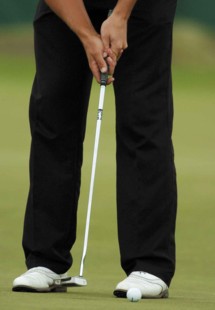
Start with your feet to improve your game.
Whether by book, television show or golf instructor, we are told time after time to check our fundamentals: grip, aim and alignment. It’s a mantra we should be practicing all the time. But it all means nothing if you are not grounded.
Well, what does that mean?
With the assistance of gravity, your feet are the only thing that keeps you connected to planet Earth while you play golf. And they are the starting point from which all your body’s action and club head speed is generated. The speed increases as the club head follows a path starting at the ground through the feet, legs, torso, shoulders and arms. The best golfers in the world have learned to harness this power, and so can you.
So, to change your game, you’ve got to build a solid foundation, and it all starts at your feet.
Your feet are one of the most overlooked areas of your body that can dramatically influence your golf swing. If you don’t feel solid and secure on your feet, everything else from the ankle up suffers. Tight muscles and poorly moving joints are usually the culprits when it comes to poor movement. The first step to understanding your feet and ankles, and whether you are properly balanced is to know where your center of gravity rests in your feet. One way is to stand upright, walk in place for three steps per leg and then come to a nice, relaxed stop. Try to feel where most of your weight is centered on your feet. It should be just slightly in front of your heels. If your feet are flat (pronated), or if you have high arches (supinated), then your center of gravity can shift around the feet. Now instead of feeling it in front of your heels, you may feel it shifted toward the back of the heels, on the ball of your feet or even out toward the side. While that may help you on hilly lies on the golf course, it generally hampers your golf swing, and you’ll never feel solid over your feet.
These improper foot positions and alignment also affect the mobility of you ankles. If your feet are pronated or supinated, it tilts the ankle joints and compresses them, inhibiting the motion of your ankles. When your ankles don’t move well you’ll start to see instability in the knees, hips and lower back because they are compensating for the ankles’ lack of mobility. Also, if the feet are dysfunctional it will affect the way you transfer the weight to and from your lead and trail leg as you swing the club.
Can the feet & ankles cause some of my swing faults?
Absolutely. When your ankles don’t move properly, it can be the primary cause of losing your posture, or spine angle, during your swing. The result is that you stand up in your back swing, thus changing the swing plane. This starts a chain of resulting swing faults, such as a flat shoulder turn, which then makes you initiate your down swing with your arms instead of our hips, and we start to come over the top with your swing. Because you stood up on our backswing, you lurch toward the ball on the down swing and hit the ball fat and chunky. Another resulting swing fault is a slide. When you don’t feel solid on your feet, other areas will move to make it feel like you are shifting your weight onto our legs. This usually results in a slide or sway of your hips. Now your hips are shifting too far toward or away from the target. This makes it very difficult for a proper weight shift and a consistent impact position of your swing. Many other swing faults can result from poor ankle and foot movements because it affects everything above it, which basically is your entire body.
Lastly, your lead foot can be a great indicator of how efficient you are with your golf swing. Go to the driving range and watch people on their down swing and follow-through. See if their lead foot changes positions dramatically. Does their foot roll excessively to the outside during their follow-through? Do they spin on the heel of the lead foot where the toes point towards the target? Did they slide their foot as they were coming into impact? You may be doing these same things. If you are, you will have poor efficiency and speed throughout the golf swing. The first step to changing these issues is to make sure your feet are grounded!
How do I know if I have any foot issues, & can I fix them?
You can check whether you have flat feet or high arches by doing the “water imprint” test. Take a piece of paper or cardboard and put it on the floor next to your foot. Take a bowl or pan of water and wet the entire bottom of your foot. Now immediately step onto the piece of paper or cardboard. Look at the imprint and compare it to the illustrations above. If your foot does not fit the normal illustration, you may be a candidate for orthotics or specific foot exercises like the one below.
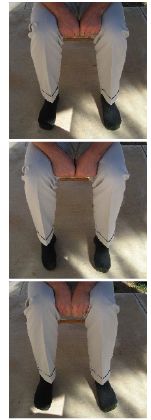
Here is a foot exercise called Flatten Arches/Form Arches that helps with the proper movement of your arch:
Sit in a chair with your feet shoulder width apart and toes facing forward. Take your fists and place them between your knees. Without moving your hips, knees or hands, try to rock your feet in and then out. Repeat this back and forth for fifteen repetitions one time per day.
Orthotics are devices that insert into your shoes and place your feet in perfect alignment to promote proper stability of the foot, especially in the arch area. As every golfer has a unique swing, every person has unique feet. That’s why it is very important to have custom orthotics created for you. There are sports health practitioners as well as podiatrists that specialize in fitting you with the appropriate orthotics. Orthotics come with different performance profiles and can be customized to your needs. Do not buy generic orthotics. Generic orthotics are created for what a manufacturer thinks is the perfect foot, not the perfect foot for you.
Can shoes really make a difference?
Who doesn’t want to be in Zach Johnson’s shoes? He is a Masters Champion, and living the golf lifestyle we would all love to live. In a very humorous commercial Zach is in a situation where he can’t find his shoes in the garage. His wife eventually helps him find them among hundreds of shoe boxes lining the wall. Zach has the luxury of his choice of any shoe to use when he plays golf. Despite the fact that most shoe designs are more of a fashion statement, the reality is that Zach, like most professional golfers, plays with a particular type of shoe that works for his foot mechanics. Very often we’ll choose a shoe for looks instead of fit. That’s a big mistake, since ill-fitted shoes can dramatically affect foot and ankle motion.
Shoes come in three different types. One type is the platform stability shoe, which anchors the lower body to the ground, enabling you to create greater force. It also controls the motion of your feet. Unfortunately, they take some time to break in and feel comfortable. The second type is the high-comfort shoe, which gives you flexibility and cushioning for your feet. Lastly, the mid-stability shoe combines the features of the previous two types. Of all the shoes on the market, there are only a few models that allow for orthotics. If you want to use orthotics in shoes not designed for them, buy a shoe one-half size larger, which allows enough room for your foot and the orthotic.
Shoes come in widths from 4E-wide to narrow. Selecting the proper width is just as important as the motion control these shoes provide. If you have a wide foot in a narrower shoe size, you will typically experience a “pinching” restriction in foot movement, as well as pain after walking even a small distance. Too wide of a shoe provides less support, resulting in an unstable stance. So have a professional help fit you to the correct shoe so you can play better golf.
Your feet are one of the most important assets to your sense of balance. Jack Nicklaus once said that the golf is played between your feet. What he was referring to was balance and your ability to effectively shift your body weight between these two points. If you don’t have balance during your golf swing, you most likely have a bad swing.
Balance is managed by three systems: your eyes, your ears and your proprioceptors. Try balancing on one leg. Easy enough, right? Now balance on one leg with your eyes closed. Chances are you lost your balance within seconds because you disabled one of the systems. The next system, your inner ears, has circular canals containing fluid that stimulate your sense of balance. A challenging test for your ears is the tea cups ride at Disneyland. This usually over stimulates those canals, making riders dizzy by the end of the ride. For some, the canals are so sensitive that the simple act of getting up from bed or a chair makes them dizzy. This would also affect your golfing balance. Lastly, your proprioceptors are special receptors concentrated in your hands and feet. They tell you where you are in relation to everything else. If you raise your arm above your head, you don’t have to look in a mirror to see it; you feel it because of the proprioceptors. These same receptors give you balance, timing, rhythm and feel throughout the golf swing. Without proprioceptors, you don’t have a golf swing.
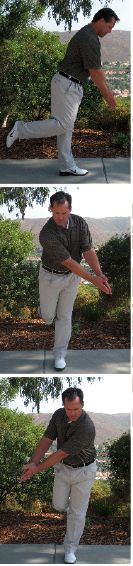
Get into your golf posture and lift one leg. Try to balance yourself, first with your eyes open for ten seconds, then with your eyes closed for ten seconds. Repeat with the opposite leg. Do this exercise three times per side, four days a week. To make it more difficult, clasp your hands together and swing side to side while performing in the same position.
Excessive knee movement also comes from your ankles & feet.
Let’s take a look at Jack Nicklaus again. Early in his career his lead knee would push out toward the ball dramatically, and that heel would lift on his back swing. While it worked quite well for Jack, it doesn’t for most others. He did it purposefully to gain power in his swing. Most people do this because of decreased ankle flexibility. This move creates inconsistency and excessive motion for most golfers. It is the enemy of a golf swing. Mechanically, it is much more sound to keep your feet on the ground. This is especially true as the flexibility and body senses decrease with age. Keeping that foot down affords you a greater sense of where you are in relation to your body during the golf swing. Unfortunately, if you are tight you will probably have to shorten your swing. That’s why flexibility is the most important fitness aspect of golf.
So now you know that short of a solid foundation, you are doomed to continual compensations in your golf swing. If your swing assessment reveals any of the flaws mentioned, start working on them immediately.
Until next time, hit ‘em straight & hit ‘em hard!
Dr. Coy Roskosky is a sports chiropractor specializing in golf fitness and injury. Dr. Roskosky is a certified level-three TPI medical provider, and instructs future golf professionals on evaluation, fitness and performance at the San Diego Golf Academy.