



Training for Balance, Training for Golf
- share:
 Bookmark on Delicious
- Digg this
- Recommend on Facebook
- Share on Orkut
- Share on Reddit
- Share with Stumblers
- Tweet this
- Tell a friend

During this off season, GFM met up with Trevor Immelman and his golf performance coach, David Herman, for a few questions about Trevor achieving his boyhood dream of winning the 2008 Masters. We also got an exclusive inside look at a workout routine that Trevor uses to keep his body in perfect golf shape, and the routine he will use to prepare himself for 2009 season and to defend the Masters.
What we found was a confident, athletic golfer who has dedicated the longevity of his career to continuous improvement of his physical and mental golf fitness.
Trevor feels that he has fully “digested” his win at Augusta last spring and is now basically “working on ways to improve.” His current challenge is to bring out his best golf more times in a season. In winning his first major, his confidence has reached a new level. “I definitely feel more confident. I have proved to myself that if I play my best, I can beat the best. I now fully believe that I can win the biggest tournaments”.
Leading up to this year’s Masters, Trevor has worked hard in the off-season in a training program consistent with building and maintaining legs, upper body and core strength. He has “no worries” about his preparedness for this year, and recalled his physical challenges the prior year. After two physical setbacks in 2007—a stomach virus resulting in significant weight loss, and major surgery in December—his dedicated approach to fitness enabled him to come to form and win the Masters. “I found how important it is to have a trainer as good as Dave, who knows how to prepare an athlete in strength and nutrition”.
Though he wants to feel physically strong in 2009 and for the Masters, Trevor will tweak his routine during the tournament season by using lighter weights, simple core stabilization and more elastic stretching. The focus will be on staying pain free, loose and limber for tournament play, and not lifting heavier weights, which would cause too much stiffness.
Trevor further elaborated on the critical importance of overall fitness to an extended career in professional golf. “Golf is such a different animal than other sports when it comes to training. With other sports such as football or baseball you are lucky to have a 10-year window,
so you have got to hit it with your maximum training. In the sport of golf, your training is more centered on preventing injuries and adding longevity to your game and your career; a sport where you want to play competitively until you are 50 or 60. You just need to be fit enough to play 72 holes, never loose concentration, never get tired, and enable your body and muscles to support your swing, all in an effort to avoid injury. It’s a little different balance than any other sport, and that’s how Dave and I got onto this angle for golf-specific conditioning and the work-out we are going to show you today.”
As we discussed strengths and weaknesses in Trevor’s golf swing, he explained that one of his strongest assets creates one of his greatest weaknesses from a technical standpoint. “I have very strong hips, glutes and legs. That’s why I can create a lot of speed and hit the ball so far, particularly for such a small guy”. Technically, this hinders him because his hips move very fast. Consequently, he concentrates on his rhythm while on the golf course to balance his strength training in the gym
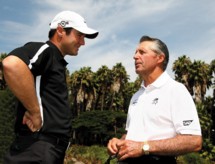
Trevor Immelman
Training for Balance, Training for Golf
By: Steve Gomen with David Herman
During this off season, GFM met up with Trevor Immelman and his golf performance coach, David Herman, for a few questions about Trevor achieving his boyhood dream of winning the 2008 Masters. We also got an exclusive inside look at a workout routine that Trevor uses to keep his body in perfect golf shape, and the routine he will use to prepare himself for 2009 season and to defend the Masters.
What we found was a confident, athletic golfer who has dedicated the longevity of his career to continuous improvement of his physical and mental golf fitness.
Trevor feels that he has fully “digested” his win at Augusta last spring and is now basically “working on ways to improve.” His current challenge is to bring out his best golf more times in a season. In winning his first major, his confidence has reached a new level. “I definitely feel more confident. I have proved to myself that if I play my best, I can beat the best. I now fully believe that I can win the biggest tournaments”.
Leading up to this year’s Masters, Trevor has worked hard in the off-season in a training program consistent with building and maintaining legs, upper body and core strength. He has “no worries” about his preparedness for this year, and recalled his physical challenges the prior year. After two physical setbacks in 2007—a stomach virus resulting in significant weight loss, and major surgery in December—his dedicated approach to fitness enabled him to come to form and win the Masters. “I found how important it is to have a trainer as good as Dave, who knows how to prepare an athlete in strength and nutrition”.
Though he wants to feel physically strong in 2009 and for the Masters, Trevor will tweak his routine during the tournament season by using lighter weights, simple core stabilization and more elastic stretching. The focus will be on staying pain free, loose and limber for tournament play, and not lifting heavier weights, which would cause too much stiffness.
Trevor further elaborated on the critical importance of overall fitness to an extended career in professional golf. “Golf is such a different animal than other sports when it comes to training. With other sports such as football or baseball you are lucky to have a 10-year window,
so you have got to hit it with your maximum training. In the sport of golf, your training is more centered on preventing injuries and adding longevity to your game and your career; a sport where you want to play competitively until you are 50 or 60. You just need to be fit enough to play 72 holes, never loose concentration, never get tired, and enable your body and muscles to support your swing, all in an effort to avoid injury. It’s a little different balance than any other sport, and that’s how Dave and I got onto this angle for golf-specific conditioning and the work-out we are going to show you today.”
As we discussed strengths and weaknesses in Trevor’s golf swing, he explained that one of his strongest assets creates one of his greatest weaknesses from a technical standpoint. “I have very strong hips, glutes and legs. That’s why I can create a lot of speed and hit the ball so far, particularly for such a small guy”. Technically, this hinders him because his hips move very fast. Consequently, he concentrates on his rhythm while on the golf course to balance his strength training in the gym
And what does Gary Player—Trevor’s life-long mentor—have to say about all of this? If you recall, Mr. Player had some very inspirational words for Trevor the night before his final round at the 2008 Masters, and regularly stays in touch with Trevor. During their last conversation, Mr. Player explained how he is working on some new conditioning techniques that he felt he needed for his aging and changing body.
Trevor finds it fascinating and inspiring that at age 72, Player still looks for ways to improve. “It just shows what a positive attitude he has. We are always talking about golf fitness, and discussing conditioning techniques and stuff. He always gives me a slap in the abs just to see how I am doing.”
TREVOR’S GOLF-SPECIFIC WORKOUT ANYONE CAN DO
Trevor Immelman-who is actually a great study of golf-specific fitness himself-used the aid of his sports performance coach, David Herman, to assemble an awesome workout routine that practically anyone can safely do on their own.
David has worked with Trevor Immelman—one of the Tour’s most fitness-dedicated athletes—for quite some time perfecting golf-specific exercises. And this one is one of the best routines we have seen. It encompasses all of the important aspects of the golf swing for more strength, speed and, most importantly, longevity.
Knowing that training for golf is unique from any other sport, they formulated a routine that promotes being 100 percent balanced during the swing. Trevor assured us that “when you play a downhill lie, you will notice a difference in your stability.” David and Trevor wanted a core stabilization program that was consistent with building and maintaining leg, upper body and core strength, all aspects that promote an automatically balanced swing as well as a reduced risk of injury. What they came up with is a whole upper body and leg program that is preformed while keeping the core muscles engaged and firing throughout the entire workout.
This routine we outlined for you is an abbreviated version of a more intensive work-out that lasts up to 90 minutes for Trevor. Or, based on time limitations to balance his professional and personal life, he will divide it into two, 45-minute sessions. But for purposes of this routine designed for you, 30 minutes is all that is necessary to get through the exercises. Dave suggests a 10 minute cool down walk and light stretching to keep your muscles loose and long.
Plan to only maximize the weights to a degree where you can continue to focus on keeping your core engaged. This makes the routine very safe for any healthy golfer. “This program is all about minimizing the risk of injury to your back, both in the gym and on the course,” explained Dave.
You should begin this routine by starting with lighter weights, building yourself up as you strengthen your core muscles. Even though this routine may appear like there isn’t much to it, it involves an immense amount of strengthening to the hundreds of tiny muscles that stabilize the center of your body, not to mention the strength you will add to your upper body and legs. If you have not already participated in a program that conditions your core muscles, be sure to step into this lightly. Expect some instability and wobble with your body in the beginning. As you improve your strength, you will notice that your stabilization skills will improve automatically for better body control. This stabilization process is the result of strengthened muscles that are needed to create a more balanced and safe swing, which, of course, means more distance, lower scores and added longevity to your game!
Core & Core Stabilization Defined:
The main muscles involved in core stabilization are deep muscles such as the transverse abdominus, the multifidus and the muscles of the pelvic floor. When engaged, the transverse abdominus creates a protective barrier around your spine. It’s the deep lower abdominal muscle you work if you pull in your belly button toward your stomach while exhaling the air in the diaphragm. The multifidus is a muscle that lies along your spine from your neck to your pelvis, with short fibers connecting one bone (vertebra) of the spine to other vertebrae near it. The muscles of the pelvic floor are most noticeable when you squeeze to keep yourself from urinating.
All these muscles, and muscles closer to the surface, help with core stabilization and posture, and will also help you to move more efficiently. These closer to the surface muscles include the thoracic area of the upper back, musculature of lower back and multiple gluteus muscles. Musculature connected to the pelvic that also help to stabilize the body include quads/lateral I-t bands, adductors and hip flexors. Core stabilization strengthens the body and helps you learn to use the inner muscles that create a strong, protective and balanced center linking the upper and lower body, which is optimum for golf.